


AI Solutions for Banking: How to Streamline Financial Operations
As growing companies manage more transactions, data, and compliance requirements, their finance teams may struggle to keep up. In recent years, dedicated banking and accounting software has taken some of the burden off of their shoulders by automating certain data entry and expense categorization tasks. As we move further into the future, many teams have turned to a new solution in order to streamline finance operations: artificial intelligence.
AI can boost efficiency, improve insights, and offload time-consuming manual tasks among busy finance departments. Rather than relying on isolated pilots or specialized use cases, many organizations apply AI across a wide array of domains. As a result, finance teams that utilize AI spend 20-30% less time crunching data, per McKinsey. This begs the question: where have high-performing teams implemented AI?
In this guide, we’ll break down where AI is delivering the most practical value for finance and business operations teams, what the technology looks like in practice across different functions, and the potential risks you may encounter. We’ll also discuss Slash, a business banking platform with deep automation and AI functionality.¹ Not only can Slash automate routine tasks like transaction categorization and recurring invoices, but Slash’s built-in AI agent, Twin, can help your business analyze its finances, send payments, and control team spending just with a prompt.
What are AI Tools in Banking?
An AI tool in banking is any function driven by artificial intelligence that can complete a task without human intervention. Teams may use AI to forecast cash flow, monitor working capital, speed up reporting cycles, analyze areas for cost savings, and more. AI tools typically come in one of two forms:
- Generative AI: A type of artificial intelligence that creates new content and works with existing content by learning patterns from experiences and data. In the context of banking, generative AI can create invoices, assign tags and categories, and flag suspicious transactions.
- Agentic AI: Autonomous systems that can perceive, reason, plan, and take actions to achieve specific goals without constant human supervision. This type of AI can execute multi-step processes like purchasing goods and sending emails, sort of like a personal agent (hence the name).
As businesses look to optimize their financial processes, they may be stuck deciding between solutions that offer generative AI and ones that come with full agentic AI implementations. Each can significantly boost efficiency among different banking operations, and the type you decide on may depend on the pain points you want to target. With Slash, finance professionals can have both.
Slash users can chat with Twin, the dashboard’s built-in AI agent, to move money, dig into spending patterns, issue and manage cards, track down invoices, and much more — all through natural-language prompts, just like the AI tools you're probably already using. Paired with Slash's existing automations for repetitive finance work, Twin helps finance teams cut through the busywork and focus on the decisions that actually matter.
The standard in finance
Slash goes above with better controls, better rewards, and better support for your business.


Key Applications of AI in Financial Operations
The range of applications for AI in finance is nearly limitless, especially as agentic AI develops. Here are some of the areas that offer the most opportunity for AI integration:
Accounts payable and invoice processing
AI can support and automate core accounts payable tasks such as invoice processing, approval routing, payment handling, and data entry. The introduction of AI and machine learning algorithms to accounting systems streamlines processes that once required extensive manual effort.
Accounts payable staff is responsible for receiving invoices from vendors, validating them, routing them for approval, and executing their payment. This can involve cross-referencing related records like purchase orders and maintaining documentation for compliance and audit purposes.
AI can use optical character recognition (OCR) and natural language processing (NLP) to read invoice data from PDFs and capture specific fields, whether the documents are structured or unstructured. They can also detect potential fraud by identifying anomalies in vendor behavior or invoice patterns. Tasks like these traditionally take up a good portion of an accountant’s schedule – but thanks to AI, they no longer have to.
Expense management and spend analysis
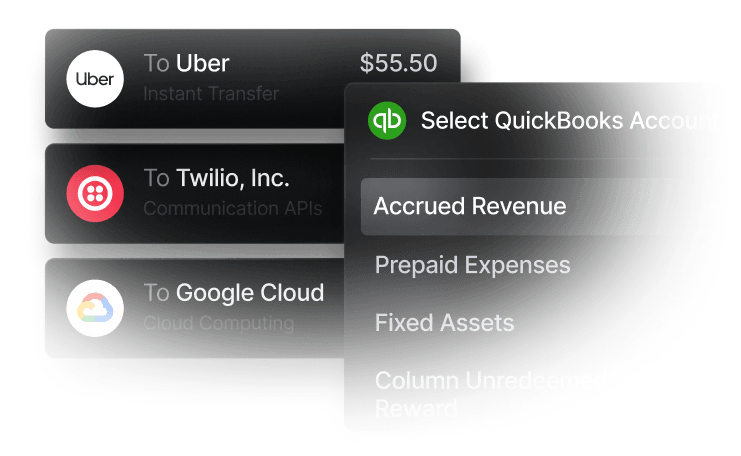
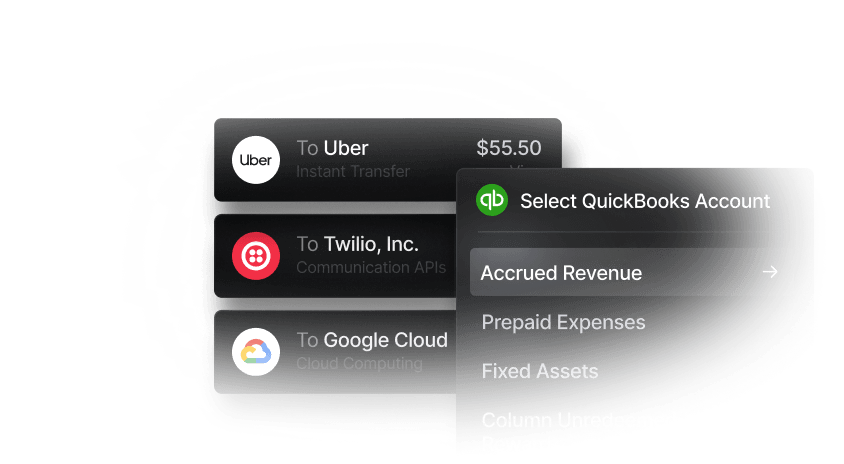
AI's ability to independently categorize and analyze large transaction datasets can transform how finance teams and CFOs understand their cash flow. Generative AI is capable of automatically categorizing transactions at the source, whether employee card expenses or vendor payments. Platforms like Slash make incoming and outgoing payments easy to track by centralizing and sorting them all on one dashboard.
From there, AI agents can not only pull insights from wide swaths of data that finance professionals may miss, but they can initiate complex tasks that help teams utilize that data. Twin, for example, can generate reports, perform calculations, and even build custom dashboards using live financial information.
Financial forecasting and planning
Similarly, AI can pore through every aspect of a company’s financial data to generate more advanced cash flow forecasts. These decision support agents can analyze complex information, simulate outcomes, and either recommend optimal actions or make autonomous decisions themselves. Companies can use these tools to substantially reduce the time their finance teams spend allocating resources and making projections. Instead of manually pulling reports and stitching together insights, teams can now use AI agents to generate complex scenarios using natural language and custom charts.
Fraud detection and risk management
Without the help of AI tools, finance professionals often have to keep a close watch over incoming and outgoing payments and make judgment calls regarding suspicious transactions. AI's ability to continuously process large volumes of transfers and flag anomalies can make it far more effective at fraud detection than any manual review process.
Transactions that deviate from a user's normal spending pattern or payments originating from unusual locations can be flagged for further investigation before they settle. AI can also scan invoices and cross-reference against purchase orders and payment history, uncovering duplicate invoices by finding patterns and similarities that employees could miss.
AI’s risk management use cases extend to compliance as well. These tools can monitor transactions and communications for signs of regulatory non-compliance, often revealing issues that would otherwise only be caught during a formal review.
The month-end close process
Reviewing, reconciling, and finalizing all financial transactions at the end of the month is a time-consuming project. Accounting teams take more than a week on average to complete their month-end close, per PriceWaterhouseCooper.
With full implementation, AI tools can speed this process up dramatically. Slash enables users to automate ERP tagging, schedule invoice reminders, and approve transactions in bulk. Since suspicious transactions are flagged for review as they occur, teams can investigate and resolve potential issues quickly instead of scrambling through a backlog at month-end.
The Benefits AI Offers Finance Teams
The deep flexibility and customizability that AI offers result in a wide range of advantages to finance teams. These benefits include:
- Easy scalability: A company that hires extra finance professionals to manage volume will tend to face constraints as the business grows. AI, on the other hand, can handle increased work without additional labor cost. This allows teams to take on larger transaction volumes and more complex workflows without an increase in headcount or slowdown in progress.
- Reduced manual workload: Invoice processing, account reconciliation, transaction categorization, and expense policy enforcement are all high-volume processes that can be automated by AI. Removing human involvement from these procedures reduces both the time they take up and the stress that they bring.
- More accurate data entry: While artificial intelligence isn’t fully immune to mistakes, modern AI tools often make fewer errors than overworked finance teams. This is especially true when it comes to data transcription between documents or solutions, as AI won’t misclick keys when it copies over hundreds of spreadsheet cells.
- Faster, more confident decision-making: AI surfaces relevant data on demand, runs scenario analyses in real time, and flags anomalies before they become problems. This allows finance teams to be better positioned to answer strategic questions that may have required a deep search or complicated calculations. If you choose to give it the privilege, agentic AI can make some of these tough decisions for you.
- Better cash flow visibility: AI that works with your company’s financial data is often capable of making it more transparent. Agentic AI tools like Twin can be prompted to create bespoke dashboards that display anything from a specific piece of your financial processes to your entire cash flow.
- Improved compliance and audit readiness: Complex tasks like recordkeeping and reporting can be automated by AI-driven systems. These tools can also maintain audit trails automatically, flag non-compliant spend in real time, and compare organizational data with relevant regulations.
Risks and Challenges of AI Adoption in Finance
As advanced as AI is, it’s not a “plug-and-play” solution. When you implement new tools, you may run into both technical limitations and organizational obstacles. Here are some pain points to watch out for:
- Data quality and integration issues: AI models are only as reliable as the data they’re given. If a business operates across fragmented platforms, or if it relies too heavily on error-prone human input, AI will be stuck working with incorrect or misaligned information. While machine learning can do a lot, it can’t identify and fix bad data.
- Bias and poor logic: In the context of AI, bias refers to past machine learning that leads models to make incorrect decisions or calculations. For example, if an AI sees a trend in spending patterns, it may incorrectly apply that trend to a projection where it doesn’t fit. Since AI agents communicate via natural language, users can “coach” some models and address errors on the spot.
- Difficulty scaling from pilot to production: Some companies successfully demonstrate the value of AI in controlled pilots, then struggle to fully integrate them across their workflows and into their systems. While technical issues and incompatible programs may be one reason for this, confusion from your team can be another. It’s important to begin with a fully structured plan; you won’t find success by tossing AI into a system and hoping it figures itself out.
- Security and data privacy risks: Allowing AI to interact with your company’s financial data introduces a certain level of risk, especially with agentic tools that can execute actions. This security risk increases significantly when vendor and client data is involved. Institutions that use their AI to handle sensitive consumer details should make sure their infrastructure meets the same security standards that apply to any system that contains third party data.
The standard in finance
Slash goes above with better controls, better rewards, and better support for your business.


How to Successfully Implement AI into Finance Operations
Implementing AI into your financial systems correctly is about more than just the tools themselves. There are several strategic and architectural considerations financial institutions should be mindful of, including:
Starting with high-impact, well-defined use cases
Traveling from an AI pilot program to full implementation shouldn’t be a high-speed transition. Along the way, businesses should begin with use cases that have a well-defined problem, measurable outcomes, and manageable data requirements. These cases may be found in high-volume operational areas like fraud monitoring or reconciliation. It’s not the best idea to divide AI priority evenly between complex procedures like invoice processing and peripheral ideas like website SEO/AEO.
Cleaning up your data infrastructure
If you don’t understand how your data connects between different platforms, your AI tools probably won’t either. Clean, consistent information is the foundation for optimal machine learning and accurate output. Organizations that try applying AI technology to scattered data may find that their tools produce unreliable outputs, hurting efficiency instead of helping it.
Integrating AI into existing systems
When connecting AI to your existing system, users won’t have to worry about switching contexts, manually exporting data, or running parallel workflows. Whether your core financial platforms and ERP systems are compatible with AI tools is another question entirely. Application programming interfaces (APIs) are the key to solving some implementation obstacles. API-driven architectures allow AI capabilities to be embedded incrementally across workflows, reducing the integration hurdles that bog down large-scale deployments.
Maintaining oversight and governance
Businesses won’t get the most out of their AI tools without consistently supervising performance and working on methods of improvement. You may develop governance frameworks that define who owns each AI model, how it’s monitored, what the escalation path looks like when exceptions occur, and how model performance is tracked over time. After all, the goal isn’t to completely remove humans from finance decisions; it’s to lift the burden of low-stakes decisions while allowing intervention for important issues.
Introduce Agentic AI to Your Finances With Slash
Finance teams lose time to two kinds of work: the repetitive tasks that pile up every week, and the one-off investigations that pull someone out of focus for an afternoon. Most platforms only help with one side of that equation. Slash handles both.
On the repetitive side, Slash automates the work that used to eat your team's calendar: expense categorization, transaction tagging, invoice management. From there, Twin can take on the complex, multi-step requests that used to mean clicking through screens or pouring through documents. Through prompts in plain English, Twin can:
- Investigate transactions and dig into spending patterns across cards, vendors, or time periods
- Issue, freeze, and manage virtual and physical cards, including setting spend limits and merchant controls
- Draft and send payments with your review and approval
- Track down and manage invoices, including payment status and reminders
- Generate reports and build custom dashboards from your live Slash account data
- Categorize transactions and help you reconcile against your connected accounting software (QuickBooks Online, Xero, or Sage Intacct)
- Surface anomalies and flag unusual activity for your review
Less time stitching tools together or chasing down data, more time on the decisions that actually move your business forward. Ready to put agentic AI to work on your finances? Start with Slash and meet Twin today.
Apply in less than 10 minutes today
Join the 10,000+ businesses already using Slash.
Frequently Asked Questions
What is Robotic Process Automation (RPA)?
Robotic Process Automation is a system that uses software bots to automate repetitive, rules-based financial tasks such as invoice processing, bank reconciliations, and data entry, mimicking human actions to increase speed and eliminate errors. It's one of the oldest and simplest forms of AI automation.
Can AI tools connect to my accounting software?
The answer to this question widely depends on the software itself. Through Slash’s integrations, Twin can connect to QuickBooks Online, Xero, and Sage Intacct. Once our platform pulls the data from those solutions, Twin can work with it.
Accounting Automation: What It Is, How It Works, and How It Can Streamline Your Business Finances


