


P-Cards vs Corporate Credit Cards: Differences and Similarities
Today’s business leaders have a smorgasbord of options when it comes to spending tools. Two of the most popular, purchasing cards (P-cards) and corporate credit cards, look fairly similar on paper. Both are business payment cards issued on major card networks, both give employees a way to spend without a purchase order or out-of-pocket reimbursement, and both show up on the same kind of monthly statements. From a distance, some might assume they're just different names for the same thing. They're not.
These two card types are designed for separate spending workflows and carry meaningful differences in control structure, reconciliation logic, and organizational fit. Deploying the right tool for the right workflow is what determines whether your card program reduces operational friction or adds it.
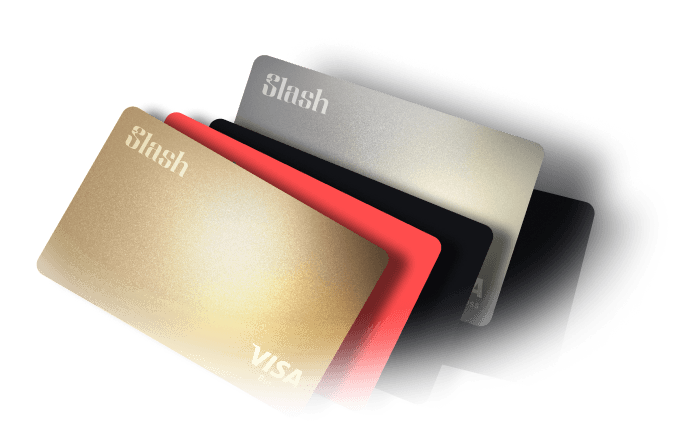
The choice between them isn't always obvious — and for many businesses, the answer is neither exclusively one nor the other. This article defines both card types clearly, works through where they genuinely overlap, and explains the operational and structural differences that matter when choosing between them. We’ll also take a look at the Slash Visa® Platinum Card, a charge card that takes the best features of p-cards and corporate credit cards and brings them together.¹
What Is a P-Card?
A P-card, otherwise known as a purchasing card or procurement card, is a payment card designed specifically to streamline the procurement process. Where a traditional procurement workflow requires a purchase requisition, manager approval, a purchase order, invoice matching, and then payment, a P-card collapses that chain. The employee with a P-card can make a business purchase directly without triggering a formal approval process, while the spend controls are embedded in the card itself.
P-cards are typically configured with granular restrictions: approved vendor categories (Merchant Category Codes), single-transaction dollar limits, daily or monthly spend caps, and in some cases vendor-level restrictions that limit the card to a specific supplier. These controls enable traditional compliance work to be completed faster and with less administrative overhead.
P-cards are most common in mid-sized to large organizations with high volumes of lower-dollar operational purchases, such as office supplies and IT peripherals. They're built for procurement efficiency at volume, not for employee travel or general business expenses.
What Is a Corporate Credit Card?
A corporate credit card is a payment card issued in the business's name and assigned to individual employees for business-related expenses. Unlike small business credit cards (which typically require a personal guarantee from the owner), corporate cards are issued based on the company's financial standing without personal liability for the cardholder. Factors providers evaluate may include revenue, cash on hand, and credit history.
Corporate cards cover the broader range of business expenses employees incur, such as flights, hotels, client dinners, conference registrations, software subscriptions, and the miscellaneous purchases that don't fit a procurement workflow. They're designed for individual expense management rather than centralized purchasing, and typically integrate with receipt capture tools and accounting systems to handle the downstream reconciliation.
Modern corporate cards like the Slash Visa® Platinum Card include spend controls similar to what P-cards offer, including per-card limits, merchant category restrictions, and real-time transaction visibility. The Slash Card also integrates with accounting tools like QuickBooks Online, Sage Intacct, and Xero, meaning controls and convenience work hand in hand.
Where P-Cards and Corporate Cards Overlap
The most important thing to understand about P-cards and corporate cards is that they share the same underlying infrastructure. Both of these cards:
- Run on standard network rails like Visa or Mastercard
- Are issued by a financial institution
- Can be virtual or physical
- Appear on card statements with transaction-level detail
- May be issued as virtual cards for online purchases, with unique card numbers
- Are often issued to multiple employees within one program
- Serve the core purpose of enabling business spending without requiring employees to pay out of pocket and seek reimbursement later
Each card type also addresses the same fundamental problem: eliminating paper-based, manual approval processes for routine business purchases. Whether the card is labeled a P-card or a corporate card, giving employees a card instead of a reimbursement form reduces friction and speeds up the payment cycle. The spend data generated is also comparable; both produce transaction-level records that can feed into accounting and expense management systems with the right integrations in place.
For smaller businesses, the distinction may be somewhat negligible. A corporate card program with strong per-card controls and vendor restrictions is operationally similar to a P-card program. The divergence becomes more meaningful at scale, in organizations where procurement and employee expenses are genuinely separate functions with separate workflows, approvers, and reconciliation paths.
What Is a Corporate Purchasing Card (P-Card)? Features, Usage, and Management Tips

Key Differences Between P-Cards and Corporate Credit Cards
Primary Use Case
The clearest dividing line is the intended spending category. P-cards are designed for the purpose of buying goods and services for the company with a focus on operational supplies and recurring business inputs with established vendors. Corporate cards are designed for the spending individual employees incur while doing their jobs, which is more varied, less predictable, and harder to centrally control through vendor-level restrictions.
A purchasing department buying $30,000 a month in office supplies, IT equipment, and facilities services across a defined vendor list is a P-card use case. A sales team booking flights and hotels before a trade show is a corporate card use case.
Control Structure
P-cards are typically configured with tighter, more centralized controls because they're managing a defined procurement scope. The finance or procurement team sets parameters like approved MCCs, dollar thresholds, and eligible vendors, then those parameters apply uniformly to cardholders within that program. Controls are designed to mirror what the PO approval process would have enforced.
Corporate cards tend to offer looser controls, as employee expense spending is inherently more varied. The employee needs latitude to book any hotel in any city, eat at any restaurant a client might prefer, and buy software tools that weren't on a pre-approved vendor list. Some newer corporate card platforms have closed this gap significantly by enabling per-card controls, but the default posture of corporate card programs is more permissive than P-card programs.
Liability Structure
Corporate credit cards typically come in two liability structures: company liability (the company pays the bill, regardless of employee action) and individual liability (the employee pays the bill and is reimbursed by the company). P-cards are almost always company-liability instruments; the organization is solely responsible for all charges, which is consistent with their procurement function.
For employees, the difference matters. A corporate card on individual liability puts the employee in the position of fronting costs and waiting for reimbursement. Company-liability cards and P-cards eliminate this dynamic.
Repayment Schedule
Most corporate credit cards work like consumer-level credit cards, allowing users to develop a revolving balance that accumulates interest as time passes. P-cards, on the other hand, usually function as charge cards. This means that the balance must be paid off at the end of each period, and debt cannot be accrued. In this instance, the Slash Visa® Platinum Card is closer to a P-card, as it’s a charge card with daily repayment requirements.
Reconciliation and Reporting
When reconciling a P-card, transactions are matched against approved spending categories and vendor lists. This process is designed to replace what the accounts payable invoice-matching process would have done. Many P-card programs require cardholders to submit a transaction log at the end of each billing cycle, allocating each purchase to a cost center or GL account. The output is typically a procurement report that feeds AP rather than an expense report that feeds employee reimbursement.
Corporate card reconciliation follows expense-report logic: employees categorize their charges, attach receipts, provide business purpose notes, and submit for manager approval. The output feeds the general ledger through expense management software. The reconciliation workflow assumes more employee agency and more variability in what's being categorized — a meal with a client requires a note about attendees and business purpose; a supply order typically doesn't.
For finance teams, the downstream reconciliation difference matters. P-card programs produce structured data against a defined purchase taxonomy; corporate card programs produce more open-ended expense data that requires more employee input to be useful. Either can feed accounting systems accurately, but the volume of human judgment required is different.
Rewards and Cashback
Traditional P-card programs aren’t typically structured around rewards because they’re meant more for process efficiency than financial return. Organizations that run P-card programs often have negotiated supplier pricing that made rebate structures less vital. Corporate card programs, particularly modern fintech-native ones, often include cash back or points structures that generate real returns on spending. The Slash Visa® Platinum Card allows users to earn up to 2% cash back on eligible purchases while maintaining the control, visibility, and automation benefits typically associated with procurement-focused spend programs.
Side-by-Side Comparison
When to Use a P-Card vs. a Corporate Card
You won’t often whip these cards out for the same reasons. P-cards are the right fit when:
- The business has a defined procurement function with established vendor relationships and recurring purchase categories
- The goal is to eliminate manual purchase order and invoice-matching workflows for routine operational purchases, reducing the time between need identification and purchase execution
- Controls need to be tighter and more centralized than a typical corporate card program supports
- The spending is primarily on behalf of the company rather than on behalf of the employee, meaning the reconciliation output should flow to accounts payable instead of an expense report
Corporate cards are the right fit when:
- Employees need flexibility to spend across varying vendors, categories, and geographies
- The primary use cases include travel, client entertainment, software subscriptions, and other variable employee expenses where business purpose and attendee documentation matter as much as the amount
- The business wants to combine card spend with expense reporting, receipt capture, and accounting integration in a way that gives employees an efficient submission path and gives finance teams clean, categorized data
- Cash back or rewards on business spending is a priority, and the business wants its card program to generate a return rather than just control a cost
Sometimes, it can be best to hold both cards in tandem. P-cards can be held for procurement and operations, while corporate cards can be given to employees with travel and entertainment responsibilities. The two programs serve separate workflows, and the overhead of maintaining both can be justified at sufficient scale. For smaller or mid-sized businesses, a modern corporate card provider like Slash with strong per-card controls can often handle both use cases within a single program, eliminating the need for different reconciliation workflows.
The distinction between P-cards and corporate cards has narrowed considerably as fintech-native corporate card platforms have adopted the control features that P-cards were built around. Platforms that offer unlimited virtual card issuance, per-card MCC restrictions, vendor-level controls, and per-employee spending limits are capable of handling procurement workflows that would traditionally require a separate P-card program.
For businesses evaluating this choice today, the more useful question may not be "P-card or corporate card?" but rather "does our corporate card platform have the controls we need, or do we need a separate procurement tool?" If the corporate card program already supports the spend controls that a P-card would enforce, it may be able to serve both purposes.
Manage Your Card Spend with More Control Using Slash
If you’re still undecided between a P-card and a corporate card, then why not consider a solution that combines the best parts of both? The Slash Visa® Platinum Card is a charge card that offers users the control structure of a P-card and the flexibility of a corporate card alongside an all-in-one business banking platform.
Each card is configurable with spending limits, merchant category restrictions, and vendor-level controls that allow finance teams to enforce procurement policy at the card level. With its combination of benefits, you can make large procurement purchases and earn up to 2% cash back rewards while doing so. Additionally, finance leaders can issue unlimited virtual cards to their team for any expense category.
All transactions sync directly to QuickBooks Online, Sage Intacct, and Xero, keeping reconciliation current without manual data entry. They’re also displayed in real time on our dedicated financial dashboard. Slash provides the visibility and control infrastructure to manage all types of spend on the same card program, without the need for fractured tools.
Let’s look at some other Slash features:
- Diverse payment methods: Slash supports a wide range of payments, including card spend, global ACH, international wire transfers to over 180 countries via SWIFT, and real-time domestic payments through RTP and FedNow.
- Global USD: The Slash Global USD Account is designed as an alternative for foreign founders who want access to USD without forming a US entity.³ Balances are backed by Slash’s USDSL stablecoin, which is matched one-to-one in value with the US dollar.
- Reimbursements: Instead of managing reimbursements across multiple tools, teams can now submit, review, and approve reimbursements directly inside the Slash dashboard. Connect your bank account, upload your receipt, and let Slash capture the details.
- AI-powered finance: Our platform comes with Twin, a built-in AI agent that can be prompted with natural language to complete complex tasks. Users can ask it to create cards, pay invoices, review your cash flow, and much more.
Apply for the Slash Visa® Platinum Card today to see how we can help optimize spending across your entire department.
FAQs
Can I use a personal credit card for business expenses?
It’s possible, but not recommended. Mixing business expenses with a personal card makes bookkeeping difficult, complicates tax deductions, and can jeopardize the legal liability protections for LLCs or corporations.
How to Categorize Expenses for Your Business: Examples & Best Practices
Do any P-cards come with rewards?
Some P-card programs do offer cash back rewards, but they tend to be less extensive than those found among corporate card programs.
Business Credit Card Rewards Tax Guide: What You Should Know in 2026

What does procurement mean in a business context?
Procurement is the strategic, end-to-end process of sourcing, negotiating, and acquiring goods, services, or raw materials from external suppliers to meet operational needs.


